Han Zhang
Nothing could appear, the word “appearance” would make no sense, if recipients of appearances did not exist — living creatures able to acknowledge, recognize, and react to — in flight or desire, approval or disapproval, blame or praise — what is not merely there but appears to them and is meant for their perception. In this world which we enter, appearing from a nowhere, and from which we disappear into a nowhere, Being and Appearing coincide… Nothing and nobody exists in this world whose very being does not presuppose a spectator. In other words, nothing that is, insofar as it appears, exists in the singular; everything that is is meant to be perceived by somebody… Plurality is the law of the earth.
— Hannah Arendt, The Life of the Mind (19)
An encounter
In Virginia Woolf’s The Death of the Moth, a small moth with tiny legs struggles to continue living while the world around it carries on. The horses stand still in the fields. The birds have flown elsewhere. The power that anchors the landscape outside the window remains, in Woolf’s words, “indifferent, impersonal, not attending to anything in particular.” Against this vast indifference, the moth’s effort appears “insignificant”. Yet it is precisely through this small, struggling body that the force of life becomes so intensely perceptible.
The still horses give the surrounding world a metaphorical form. Their lives continue beside a life that is about to end. What draws me to Woolf’s writing of this scene is the distance between the enormity of that continuing world and the particularity of the moth’s struggle. His death will not disturb anything in this world. Woolf described such insignificance as a moment “when there was nobody to care or to know,” yet she noticed it. It is through her attention to this encounter that a life that might otherwise pass unnoticed becomes an occasion for thought.
Hannah Arendt’s theorizing of appearance, grounded in phenomenology, helps me understand the significance of this encounter. To appear is to appear to someone: a living recipient or spectator who can perceive and respond. We enter a world that is already inhabited by others, and our encounters with it become part of a shared existence (Life of the Mind 19). Woolf’s writing gives her encounter with the moth a literary form through which it can appear to us. We did not witness the moth’s death, but we can share her encounter with this “insignificant creature”.
What is original about this essay is the singularity of such an encounter, through language. Language participates in the constitution of thought. As we write, we discover, shape, and sometimes change what we think. Woolf’s essay is therefore more than a record of something she observed. The writing is itself part of the encounter: a particular life attending to another life, finding words through which that attention becomes available to others. Without her attention and her writing, this encounter would not have appeared in the world in this literary form.
Through my artwork The Death of the Moth, I intend to bring my encounter with Woolf’s essay into appearance in an art form that invites singular encounters from other spectators.
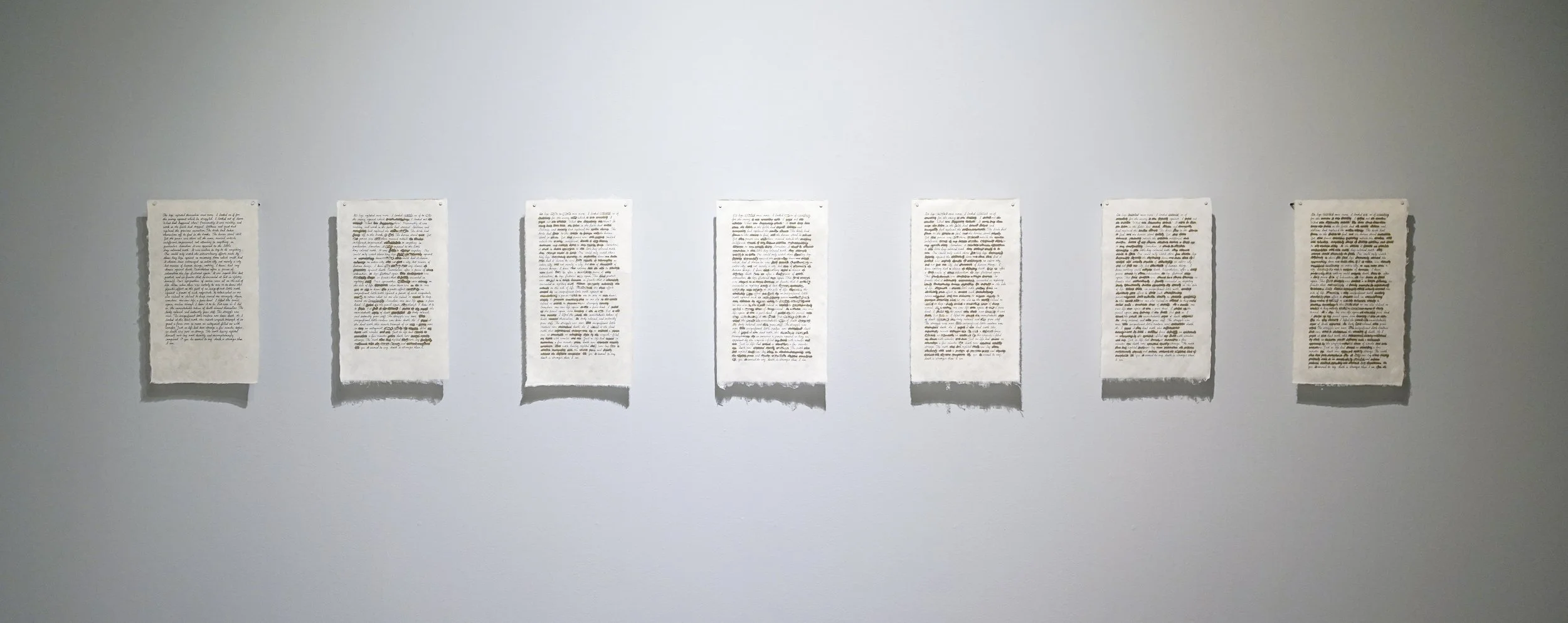
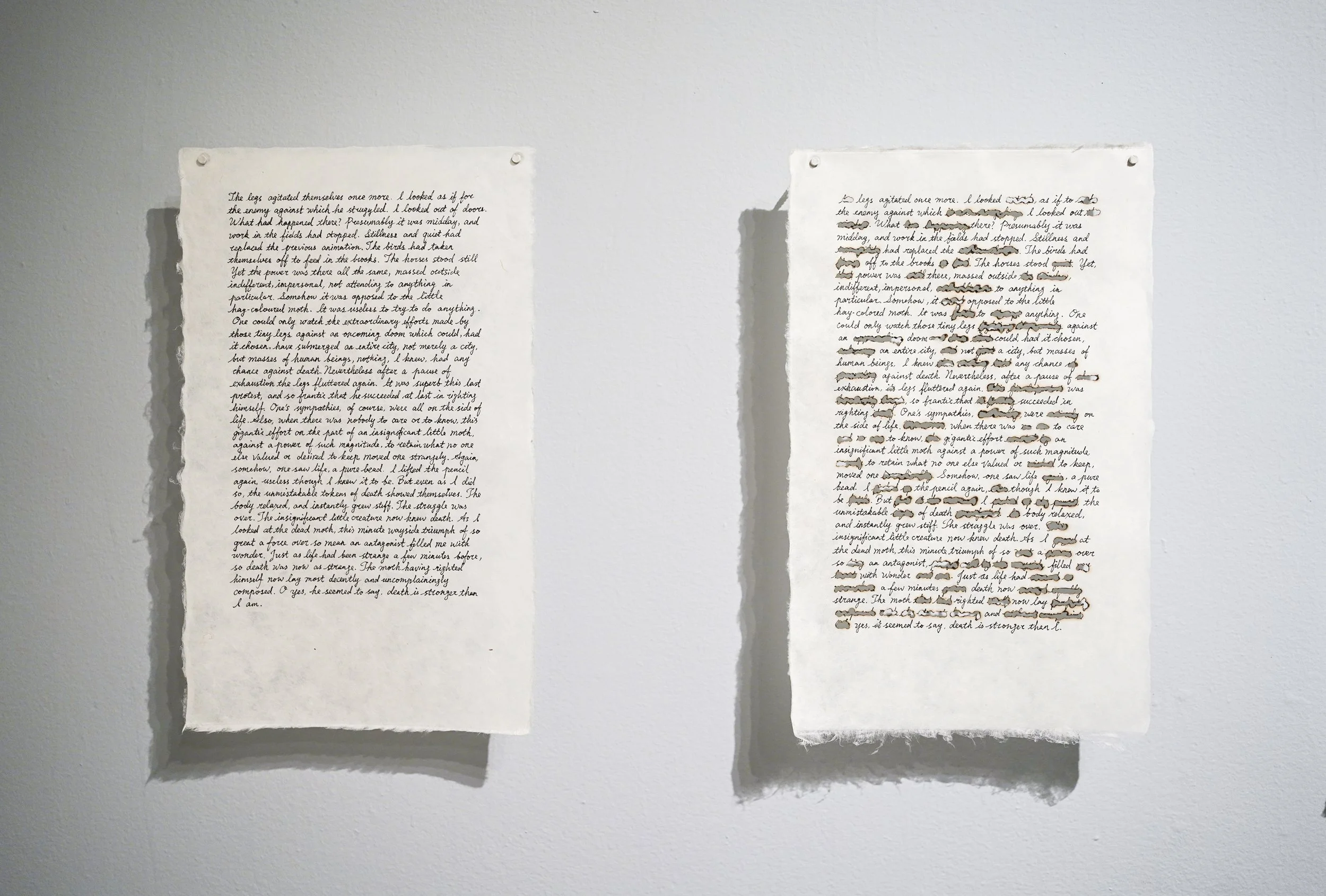
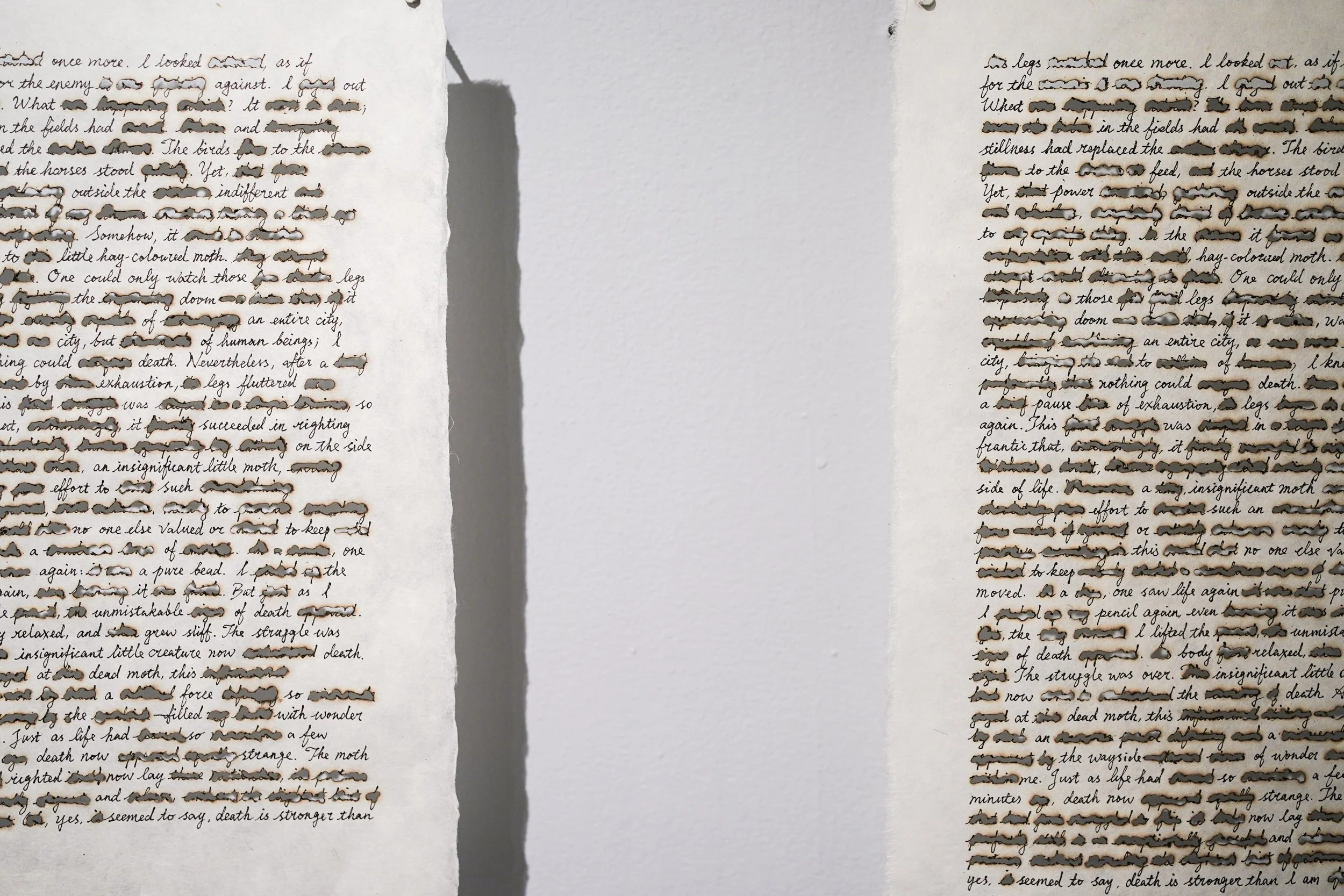
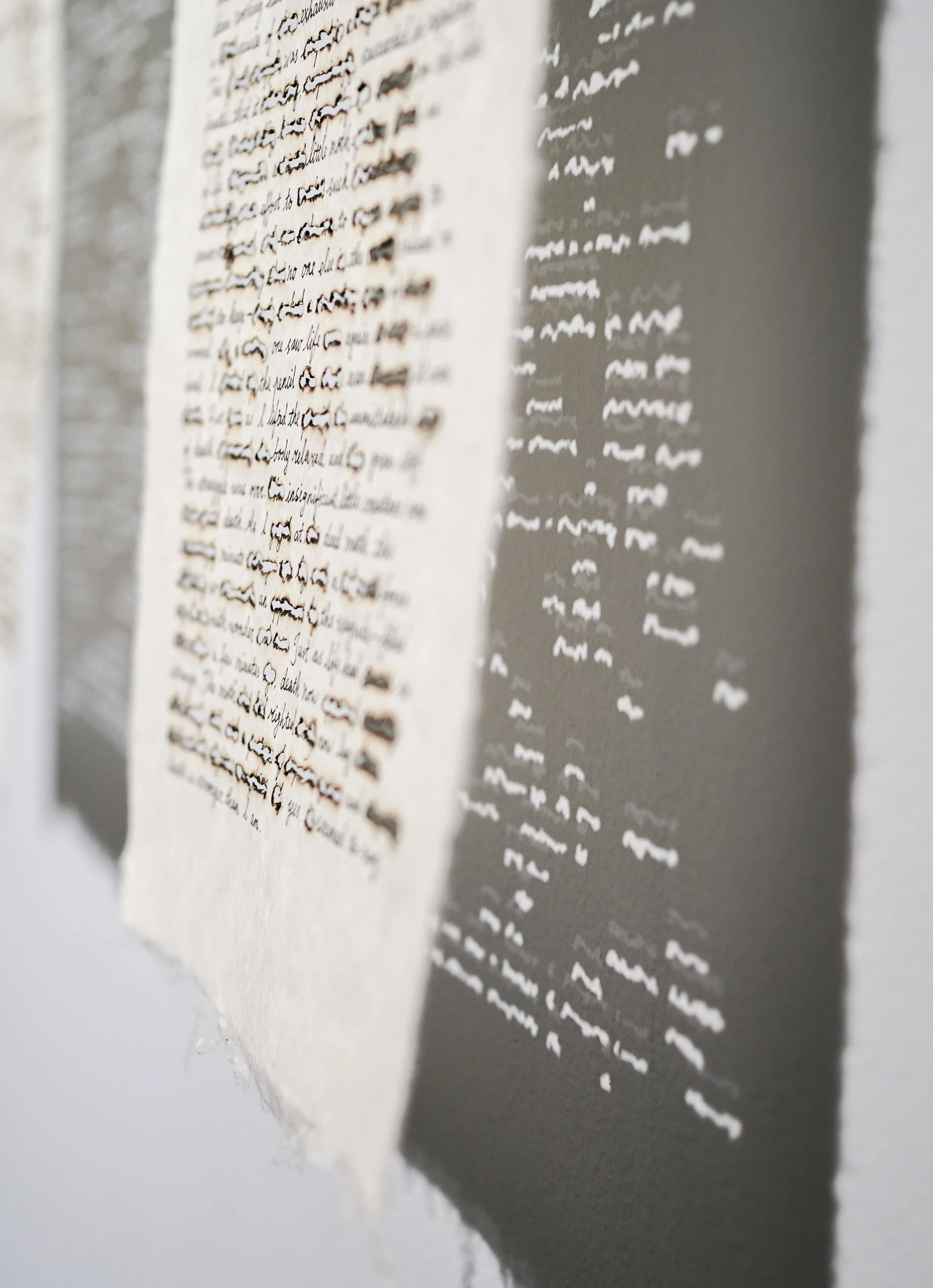
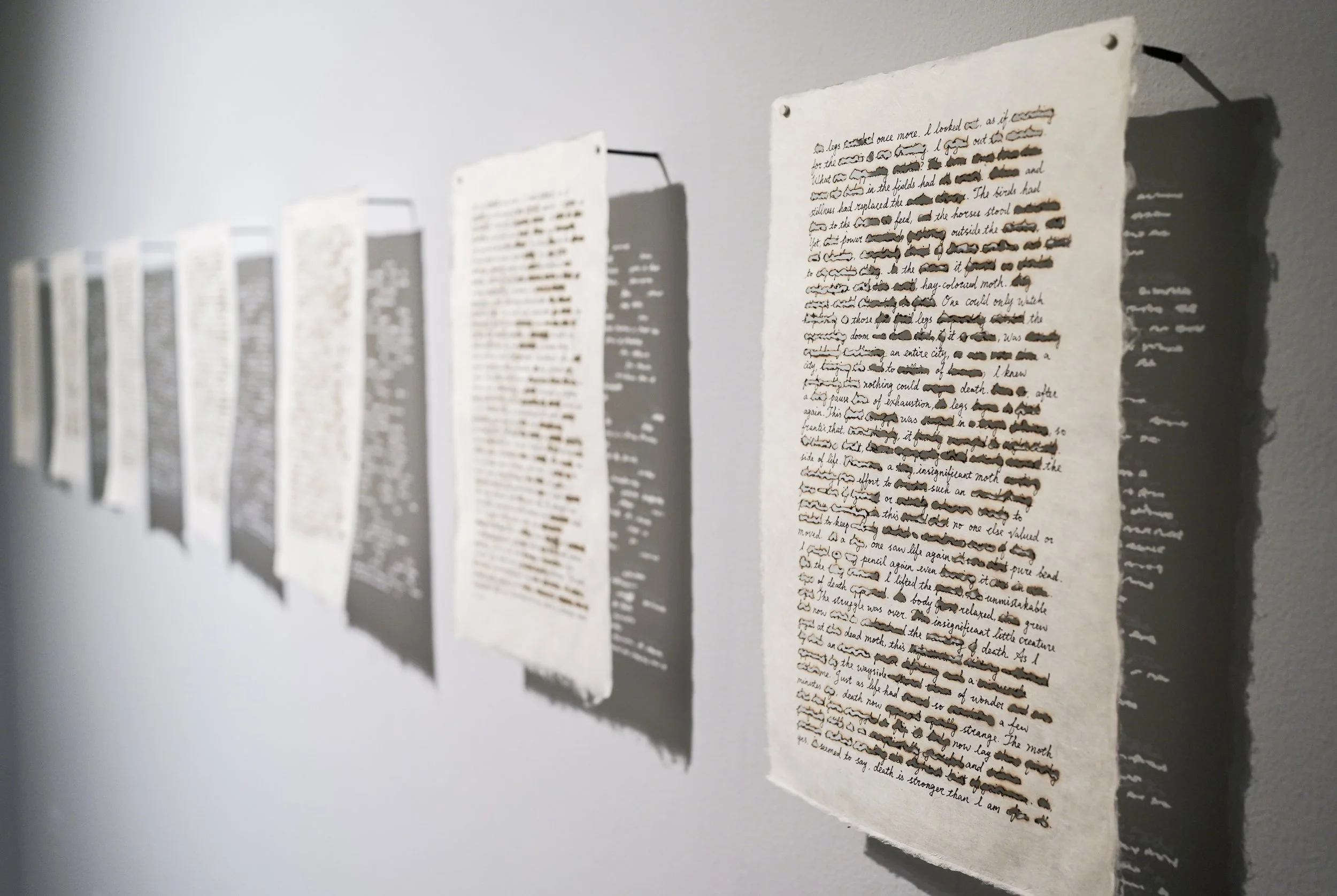
In this work, I pass the final paragraph of Woolf’s essay repeatedly between English and Chinese through Google’s Gemini large language model. Each translation becomes the source for the next, with a fresh translation prompt at each stage. The seven sheets bring together the original paragraph and six successive English translations. I write out each version by hand on handmade paper and burn away the words that have altered in comparison to the original. The sheets hang away from the wall, allowing light to pass through the burned openings.
I began with the question of what gets lost in translation. The intervention of the large language model brings another question into view. What happens when the language through which one subject’s encounter appeared is transformed by a process that does not pass through another living subject? The resulting words may remain beautiful, meaningful, and intimate. It is this intimacy, emerging through an impersonal process, that I want to examine. If the words draw us in, does it matter who, or what, produced them in the first place?
The afterlife of language
Translation has long been a subject of my work. It is a way for me to inquire into the relationship between language and experience in our shared world despite linguistic differences. A literary work gives an encounter a particular form with its rhythm, choices of words, and the relationship it establishes between what is observed and the subject observing. To translate is to approach this intersubjective and intercultural relationship through another language. The translator brings the work into a new encounter, where its meaning can continue to live on.
Walter Benjamin’s account of translation offers a unique way to think about this continuation not simply as loss, but as an afterlife in which the original lives on through transformation. In “The Task of the Translator,” he moves our fixation on treating translation as the transmission of information towards the relationship between languages, or what he calls “linguistic kinship,” which positions different languages as complementary to one another, rather than as inevitably incomparable (70-74).
The repeated passage through Chinese makes this afterlife visible in Woolf’s text. A word changes, a sentence is rearranged, a relationship is expressed differently. In the first translation, “he” in Woolf’s writing becomes “it.” This small change made me become especially aware of the intimacy carried by a pronoun. The moth remains the subject of the sentence, but the way the language invites me to regard it has shifted. A small alteration can draw attention to something I had barely noticed in the original.
Burning the altered words gives these differences a physical form. The burnt openings are not merely there to memorialize an obvious loss, nor do they measure how much meaning has disappeared. They give me a pause to wonder what an alteration actually does to the original text.
What has become less singular? What has been carried forward? What does the translated version make possible that I had not considered before? The original remains intact on the first sheet, while the others make its continuing transformation, its afterlife, visible.
The question of translation therefore concerns more than whether an original work survives. It also concerns how we encounter what survives. With a large language model, the text continues through a process whose relationship to the human encounter is different from that of a living translator. This difference is where my inquiry becomes most unsettling.
A language without a body
A human translation passes through a warm, living, and breathing body. The translator reads through a life shaped by memories, habits, desires, attachments, and encounters with the world. A sentence may evoke something, resist comprehension, or change meaning while it is being worked through. The act of translating belongs to that person’s inner, ongoing life.
A large language model operates through a mathematical model trained on patterns in human linguistic expression. Its responses are shaped by training data, instructions, and the context, preferences, or even characters, supplied to it. It can produce language about grief, wonder, or tenderness without a human actor experiencing any such particular act of articulation. The text passes through a computational process rather than another person’s lived encounter with it.
Arendt’s distinction between what someone is and who someone is helps clarify what is at stake. In The Human Condition, action means more than accomplishing a task. Through speaking and acting among others, a person enters a shared world and discloses a singular who. This who exceeds a list of qualities, capacities, or recognizable characteristics. The subject appears through a life lived in relation to others (175-81).
A large language model can adopt many voices. It can sound like a therapist, a critic, or a careful translator. These recognizable roles invite us to hear a someone behind the words. Yet, the intimate and personal form of its words does not disclose another human life. The appearance of a voice and the appearance of a who have become separable in a way that is easy to overlook.
Let’s suppose the model produces precisely the words a human translator would have chosen. Suppose its version is even better. Does it matter who/what translates the text?
The translated result no longer gives us an obvious reason to care about the difference in its production. What, then, do we value? The beauty of the language? The understanding it makes possible? The encounter with another living being’s experience and thought? The knowledge that someone has spent part of a finite life attending to these words?
I use impersonal intimacy to animate the problem. An utterance can matter intimately to its recipient without arising from another human being for whom this particular act of speaking has personal significance. This does not make the recipient’s experience unreal. Nor does it make the model’s language socially neutral. The model’s learned conventions, the decisions made during its training, and the purposes of its deployment remain implicated in human subjectivity.
What remains unsettled is how we orient to intimacy, reciprocity, and responsibility when the linguistic response no longer allows us to easily identify the interlocutor. A response can provoke me without the process producing it sharing the same significance of being provoked. This is the asymmetry that haunts me. The intimacy belongs to the encounter, but such orientation to the encounter is not shared in the familiar way. I may feel understood, challenged, or reassured, while the language that brings about these feelings has not emerged from another person for whom understanding me matters.
In other words, the language that makes me feel cared for does not care about such an encounter with me at all—like the still horses in Woolf’s landscape: "Yet the power was there all the same, massed outside indifferent, impersonal, not attending to anything in particular.” Such immense vitality continues without attending to the moth’s particular struggle. The model introduces a strange variation on this image. Its language can seem to attend to the smallest details of a life, while the process producing that attention carries no human concern for this particular life at all.
Indifference appears in the form of intimate attention.

The ghost in the language
The familiarity of these translations is part of their strangeness. The model has learned from human expression and great literature. Woolf’s writing is probably part of the model’s training material. What returns to us in these machine translations is alien to our form of life, while at the same time saturated with its traces.
Jacques Derrida’s Monolingualism of the Other gives this familiarity another dimension. Reflecting on his relationship to French and the conditions of his upbringing in colonial Algeria, he examines the difficulty of calling a language one’s own. Even the language through which we speak most intimately comes to us from others. We learn to say “I” through something that precedes us. Our singularity takes form within a “mother tongue,” an inheritance we neither created nor completely control. As he famously put it, “I have only one language, and yet it is not mine” (1-2).
The presence of a living subject has never meant that language belongs entirely to that subject. What makes an expression singular is how inherited language is taken up in an encounter with the world. This is what I recognize in Woolf’s writing. Her words participate in a shared language, while her attention gives significance that belongs to each encounter.
It is through this distinction that I approach the large language model as a ghost. I do not mean that a living subject is concealed within the machine or that the model contains the intact presence of particular authors. The ghost names a problem of attribution. In other words, a large language model inherited human histories and is conditioned by a limited and linguistic version of this shared world. Through such inheritance, language returns from human histories to us humans, in a form that is both intimate and impersonal. The language is familiar, but the familiarity does not identify who is speaking.
I think of the scale of this inheritance alongside the smallness of the moth. Each act of writing may carry the intensity of a singular encounter. Seen among immense quantities of language, it can also become almost indistinguishable. The model’s fluency brings this distance close to us. What was produced through innumerable human occasions returns as a response directed toward one person, here and now.
This ghost continues to haunt me. The machine can give back words that seem closer to what I meant than those I initially found for myself. In that exchange, the feeling of recognition can be strongest precisely where the identity of the one recognizing me is hardest to locate.
This is why intimacy and alienation become inseparable. The familiar words draw me closer, and their apparent closeness makes the absence of a familiar kind of interlocutor more striking. The ghost does not simply stand at a distance from us. It speaks in the language through which we know ourselves.
Speaking to loss
My use of burning responds to this situation. Burning, in Chinese funerary and ancestral practices, is a gesture of sending messages and offerings to the dead through fire. It is how we speak to those who are intimate yet no longer present. Burning the altered words makes loss visible by enacting it. On the surface, this may look like a protest against machine manipulation. Yet, to me, burning is an act of maintaining and sustaining a relationship. It is my way of speaking to and having an encounter with the loss.
Fire is a passage, a message. Something changes form, and through that change I establish a relationship to what can no longer be encountered in the same way.
Writing by hand brings the translated words into the time of my own body. I attend to them again, then make an opening where a word had been. The work takes shape through this passage between computational transformation and bodily attention.
Where the paper remains, it casts a shadow. Where it has been burned away, light passes through. The wall holds another configuration of the text, made from illuminated openings within the shadow of the paper. The altered words have not returned, but their removal has made something else appear. What seemed to be an ending becomes the condition for another encounter.
Benjamin’s image of translation allowing light to reach the original takes on a material presence here (79). I understand this light as an invitation to look again. The shadow brings me back to the paper, the paper to the translated words, and those words to Woolf’s encounter with the moth.
The question that remains for me is what we care about in these passages. A large language model can transform a text without sharing the human life through which it first appeared. It can return language that matters to us. The intimacy of that return makes the difference between the two processes harder to see, and more important to examine.
When language reaches us, do we value what it says, what it does to us, or the living encounter through which it came to be? What is speaking to us, and do we care who it is?
work cited
Arendt, Hannah. The Human Condition. 2nd ed., U of Chicago P, 1998.
Arendt, Hannah. The Life of the Mind. Vol. 1, Thinking, Harcourt Brace Jovanovich, 1978.
Benjamin, Walter. “The Task of the Translator.” Illuminations, edited by Hannah Arendt, translated by Harry Zohn, Harcourt, Brace & World, 1968, pp. 69–82.
Derrida, Jacques. Monolingualism of the Other; or, The Prosthesis of Origin. Translated by Patrick Mensah, Stanford UP, 1998.
Gemini Team. “Gemini: A Family of Highly Capable Multimodal Models.” arXiv, version 5, 9 May 2025, arxiv.org/abs/2312.11805v5.
Woolf, Virginia. “The Death of the Moth.” The Death of the Moth and Other Essays, Hogarth Press, 1942. Project Gutenberg Australia, Oct. 2012, gutenberg.net.au/ebooks12/1203811h.html.